Saturday, 5 November 2016

Portriat of Nikolay Gnedich by Anton Ivanov


Portrait of Nikolay Gnedich by Anton Ivanov.
Dmitry Ivanov. 2015. CC-BY-SA 4.0. The description of the photo →
Portrait of Nikolay Gnedich by Anton Ivanov. 1835. Marble.
The medaillon on the tombstone of Nikolay Gnedich in the Tikhvin Cenetry, Saint Petersburg: the marble replica created in 1961. The marble original of the medaillon (1835) is kept in the Annunciation Church of the Alexander Nevsky Lavra.
Primarily the sculptural portrait of N. Gnedich was attributed to the Samuil Ivanovich Galberg (1787—1839). Later Elena Karpova, the curator of the sculpture collection of the State Russian Museum, advanced another version: the bas-relief was created by Anton Andreevich Ivanov (?—1852), a pupil of Samuil Galber. This version is based on a report in Khudozhestvennaya Gazeta (Artistic Newspaper, 1841), where the portrait of N. Gnedich is mentioned among works by A. A. Ivanov and on the list of works by A. A. Ivanov in The Lexicon of Russian Artist by Nikolay Sobko.

Monday, 17 October 2016

The Church of Saint Basil the Great in the VDNKh


Moscow. VDNKh. The Church of Saint Basil the Great.
Dmitry Ivanov. 2015. CC-BY-SA 4.0. The description of the photo →
Moscow. VDNKh. The Church of Saint Basil the Great (Russian: храм Святителя Василия Великого). Architect: Andrey Obolensky.
The building was was under consuction in 2000—2001; in 2001 it was consecrated as a chapel by Patriarch Alexy II.
In 2011 the sanctuary was attached to the chapel and Bishop Tikhon (Shevkunov) consecrated it as a church.

The location of the Saint Basil the Great Church:

Saturday, 1 October 2016

VDNKh. Pavilion No. 8 Young Naturalists


Moscow, VDNKh. Pavilion No. 8 Young Naturalists. A general view.
Dmitry Ivanov. 2015. CC-BY-SA 3.0. The description of the photo →
Moscow. VDNKh. Pavilion No. 8 Young Naturalists. Built in 1954.
Currently (2016) the pavilion is used by the museum theater The House of Fairy Tales Once Upon a Times.

Sunday, 18 September 2016

The Bell Tower of St. John's Church at the Pine Forest in Moscow


Moscow. The bell tower of the Church of the Beheading of John the Baptist.
Dmitry Ivanov. 2015. CC-BY-SA 4.0. The description of the photo →
Moscow. The bell tower of the Church of the Beheading of John the Baptist at the Pine Forest (Russian: Храм Усекновения Главы Иоанна Предтечи под Бором). The end of the 18th century.
A view from Pyatnitskaya Street.
A notable feature of this bell tower, built in traditions of the early Classicism with some elements of the Baroque, is different stylistics of its levels. Columns of the lover level (they are not seen on this photograph) are in the Doric style, the medium level is built according to the Ionic order, the columns of the upper level are the most spectacular, they have Corinthian capitals.

The location of the bell tower of the Church of the Beheading of John the Baptist:

Tuesday, 30 August 2016

Grocery Stores of the VDNKh


Moscow, VDNKh. The Grocery Store, the former pavilion of Glavkonserv.
Dmitry Ivanov. 2016. CC-BY-SA 4.0. The description of the photo →
Moscow. VDNKh. The Grocery Store.
The buiding was constructed in 1954 as the trade pavilion of the Glavkonserv (the Main Directorate of the Packing Industry), in 1958—1959 it was used as the exhibition hall Preserved Food, in 1959 it was restructured for a grocery store.

The location of the building depicted on the photograph:

Saturday, 20 August 2016

Fire Engines: PMG-1


The PMG-1 (Russian: ПМГ-1) fire engine based on the GAZ-AA truck was the most widespread Soviet fire truck of 1930s.
Currently the most of the PMG-1 trucks are lost; this museum specimen is kept at a fire station in Balashikha, Moscow Oblast, Russia

A PMG-1 fire engine bazed on a GAZ-AA truck.
Dmitry Ivanov. 2015. CC-BY-SA 3.0. The description of the photo →
A Soviet PMG-1 fire engine.

Saturday, 13 August 2016

The Sentry


Moscow. A sentry at the Tomb of the Unknown Soldier.
Dmitry Ivanov. 2014. CC-BY-SA 3.0. The description of the photo →
A private of the Kremlin Regiment at the Tomb of the Unknown Soldier in the Alexander Garden, Moscow, Russia.

The location of the post depicted on the photograph:

Saturday, 6 August 2016

Saint George attributed to Vasili Yermolin


From the collection of the Tretyakov Gallery


Moscow. The Tretyakov Gallery. Saint Geoge attributed to Vasili Yermolin.
Dmitry Ivanov. 2014. CC-BY-SA 3.0. The description of the photo →
Saint George. A fragment of the destroyed sculpture. 1464 (?). Coloured stone. The Tretyakov Gallery, Moscow, Russia.
The statue was a decoration of the Frolovskaya Strelnitsa (barbican) of the Moscow Kremlin and, later, of the Spasskaya Tower (initially the Frolovskaya Tower) built in 1491 at the site of the demolished barbican.
It was believed that the statue was sculpted by Vasily Yermolin, who was known as a merchant and contractor. Now reseachers call this attribution in question: Yermolin was the purchaser, but not the author of the sculpture. Most probably, the statue was created by masters from Italy.

Saturday, 23 July 2016

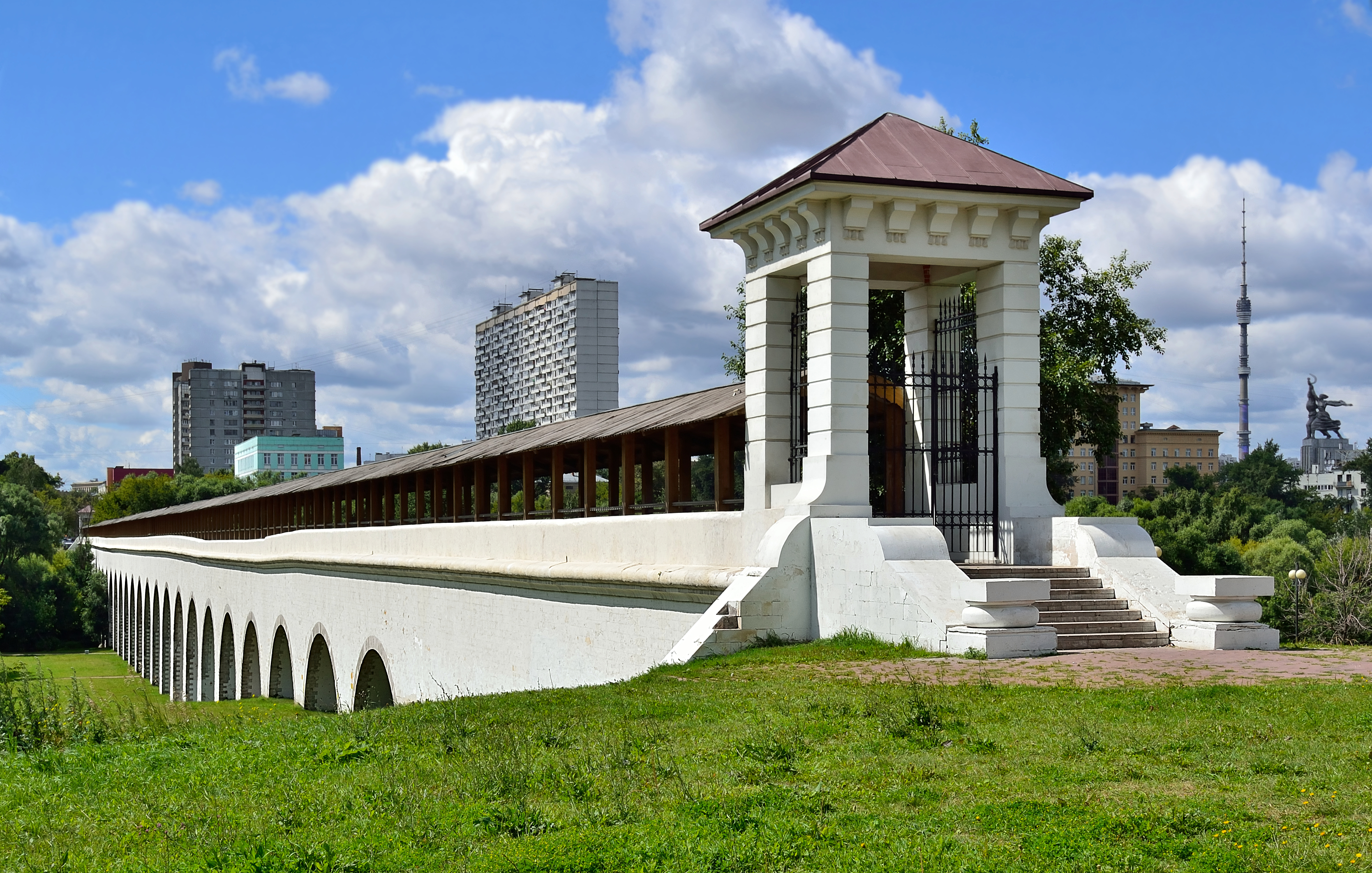
The Rostokino Aqueduct


The Rostokino Aqueduct is a stone aqueduct over Yauza River situated in Moscow, Rostokino District.
The construction of the aqueduct started in 1780 and dragged for 25 years, until 1804. More than 1 million rubles were spent on building work therefore the aqueduct has the second, unofficial, name the Million Bridge.
The aqueduct was used as an engineering structure until 1990s. In 2004–2007 it was reconstructed as a pedestrian bridge.
Moscow. The Rostokino Aqueduct. The northern entrance to the aqueduct Dmitry Ivanov. 2015. CC-BY-SA 4.0. The description of the photo →
Moscow. The Rostokino Aqueduct. The northern entrance to the aqueduct.